
The Spring Inventory Paradox
Why the South Bay Is Tightening While the Rest of the Country Loosens

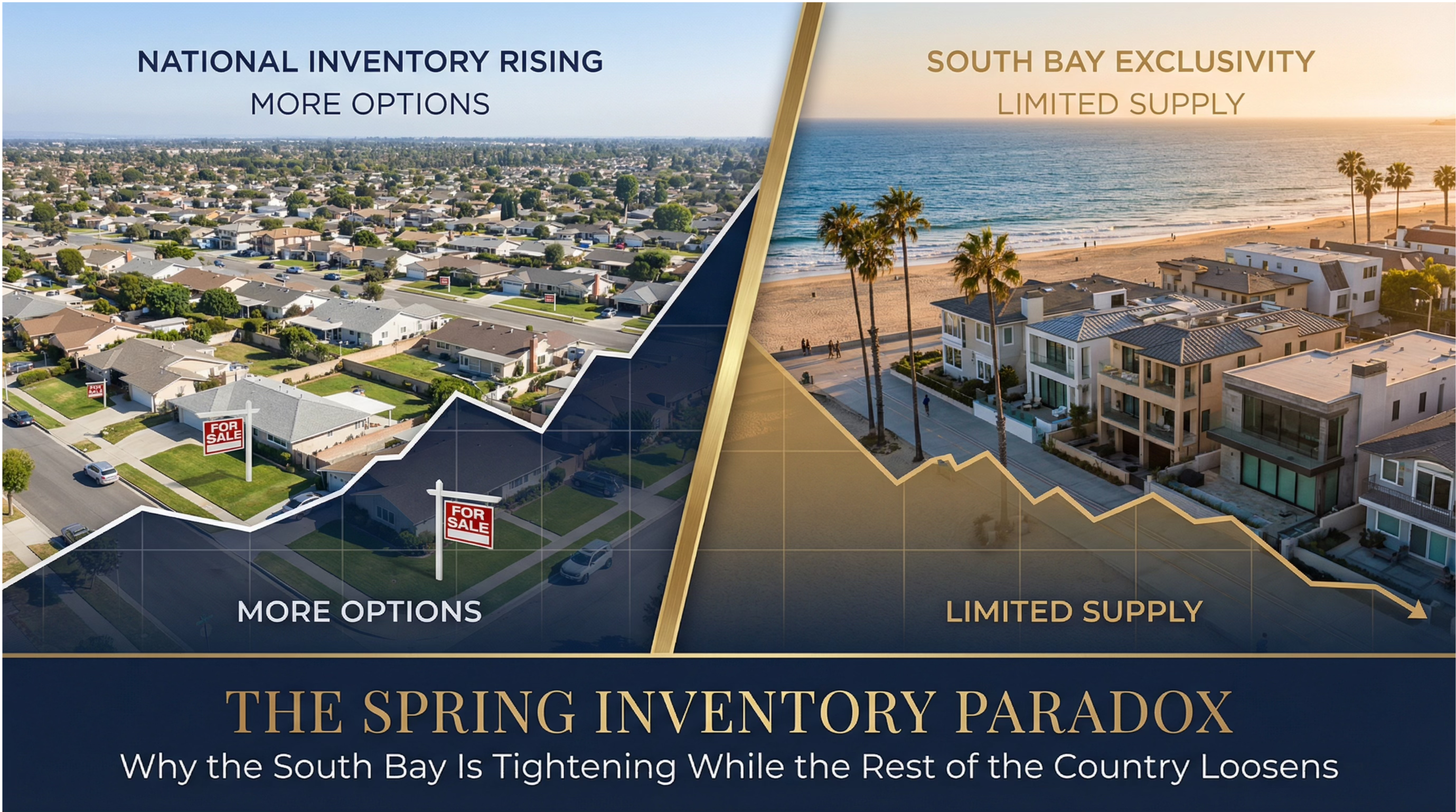
If you’ve been reading the national housing headlines this week, you’d think the spring market is about to be flooded with homes. Inventory is up. Relistings are surging. Prices are softening. The narrative is clear: sellers are finally coming back, and buyers are about to get some relief.
There’s just one problem. In the South Bay, the opposite is happening.
Manhattan Beach just posted its busiest February in years. Hermosa Beach inventory is shrinking, not growing. And the data reveals a structural paradox that most national coverage completely misses: the higher the price point, the tighter the supply — and the South Bay sits squarely in the zone where the national inventory recovery has barely arrived.
This week, I’m going to walk you through the numbers, explain why the national story doesn’t apply here, and lay out what it means for buyers and sellers in Manhattan Beach, Hermosa Beach, and both North and South Redondo Beach heading into spring.
The National Picture: More Homes, More Choices, Softer Prices
Let’s start with what the data actually says at the national level, because the headlines aren’t wrong — they’re just incomplete.
Realtor.com’s February 2026 housing report, published March 5, showed that active listings nationwide climbed 7.9% year over year, marking the 28th consecutive month of inventory gains. [1] New listings grew 2.4%. Pending home sales jumped 4.2% annually — the largest increase since November 2024 — boosted by mortgage rates that fell below 6% for the first time since 2022. [1]
Meanwhile, Redfin reported that nearly 45,000 homes that were delisted in 2025 came back to market in January 2026 — the highest January relisting figure in records dating back to 2016. [2] Sellers who pulled their homes last year are betting on a stronger spring. CNBC, Nasdaq, and a half-dozen other outlets ran the story. The message was unmistakable: supply is loosening.
And at the headline level, prices are cooperating with that narrative. The national median list price fell 2.1% year over year to $403,450. In the West region, it dropped 2.2%. Time on market stretched to 70 days nationally, four days longer than last year. [1]
If you stopped reading there, you’d conclude that the housing market is finally tilting toward buyers. And in many parts of the country, it is.
But the South Bay is not “many parts of the country.”
The South Bay Reality: Tighter, Faster, More Competitive
Here’s what’s actually happening in our three cities.
Manhattan Beach recorded 30 new escrows in February 2026 — up 11% from the same month last year. [3] That’s not a market that’s loosening. That’s a market that’s accelerating. As of February 28, there were 55 active properties on the market: 39 single-family homes and 16 townhomes. [4] For context, the broader Los Angeles metro saw active listings rise 9.9% year over year, but new listings actually fell 2.9%. [1] The pipeline of new supply is shrinking even as demand picks up.
Hermosa Beach tells an even more striking story. Active inventory dropped from 34 listings in December 2025 to just 28 by mid-February — a 17.6% decline in less than two months. [5] The 12 homes that closed in February averaged 69 days on market. Condos sat longer — 95 days on average — but here’s the twist: they still sold at or above asking price. Buyers are patient and selective, but when they commit, they’re paying full price.
Redondo Beach has the most inventory of any South Bay beach city, with 36 houses and 66 condos active as of mid-February. [5] But the two halves of Redondo tell distinctly different stories.
North Redondo (90278) is the pace-setter. Homes are going under contract in a median of just 26 days — faster than Manhattan Beach (85 days) and Hermosa Beach (69 days) by a wide margin. North Redondo also set a new record sale at 3405 Johnston Avenue — $4.3 million. [5]
South Redondo (90277) operates at a different rhythm. With its coastal Esplanade properties, Riviera Village, and harbor-adjacent homes commanding higher price points — median listing prices for single-family homes sit around $2.5 million — days on market stretch to 46 for houses and 91 for condos. [10] The median sale price in the 90277 zip code reached $1.7 million in January, up 0.9% year over year. [10] South Redondo’s pace is slower, but the pattern is familiar: buyers are discerning, not absent. The Esplanade just recorded a $4.3 million sale on March 9 — evidence that when the right coastal property hits the market, capital is ready to move. [10] South Redondo’s longer days on market actually reinforce the article’s central thesis: at the highest price tiers, the lock-in effect is most pronounced, and the buyers who do transact are deliberate and well-capitalized.
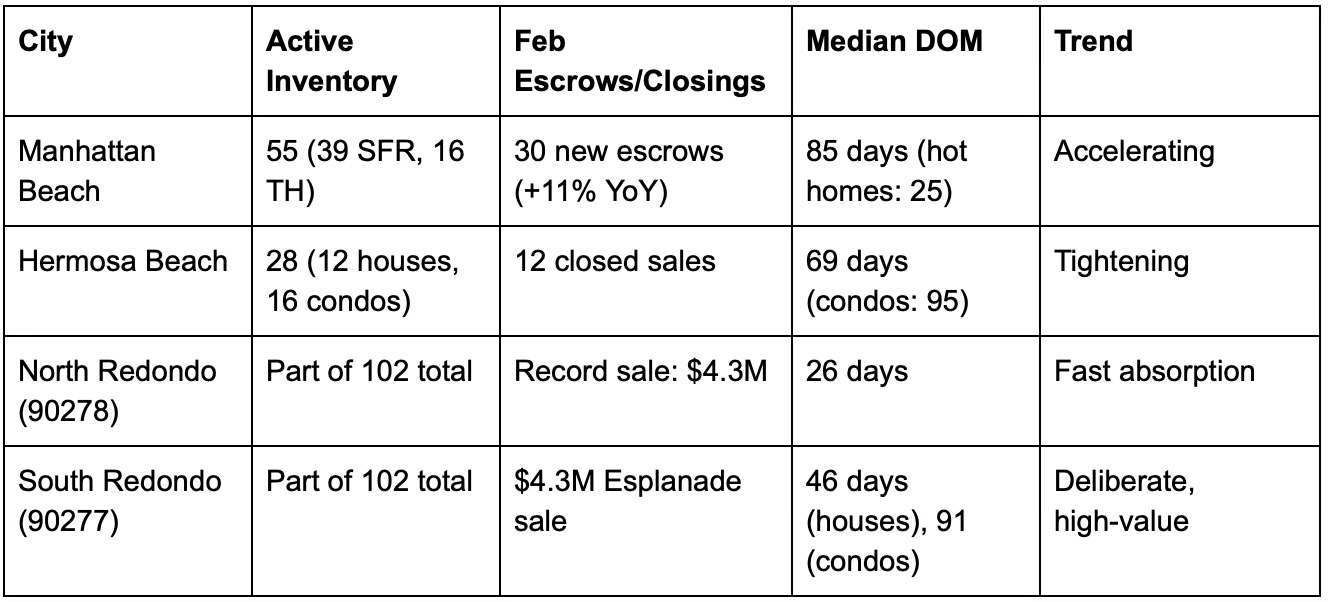
The contrast with the national data is stark. Nationally, inventory is growing and time on market is stretching. In the South Bay, inventory is flat or shrinking, escrows are rising, and well-priced homes are moving quickly.
The Price Tier Paradox: Where Inventory Isn’t Growing
The most important chart in Realtor.com’s February report is one that most commentators glossed over. It shows inventory growth by price tier since February 2024 — right around when the national recovery started gaining momentum.
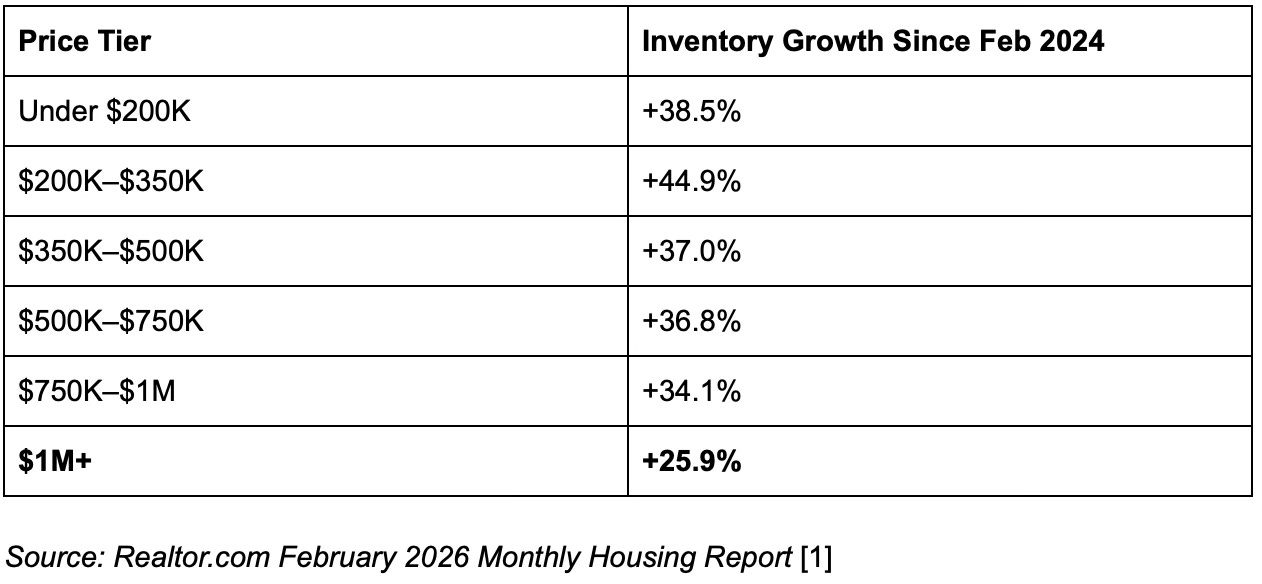
Read that bottom row carefully. At the $1 million-plus tier — which is where virtually every single-family home in Manhattan Beach, Hermosa Beach, and most of Redondo Beach is priced — inventory growth has been the slowest of any price bracket over the past two years. The national inventory recovery is overwhelmingly a story about homes priced under $500,000, concentrated in the South and West regions outside of coastal California.
This is the paradox. The headlines say “inventory is rising.” The data says “not where you live.”
The South Bay’s median listing prices — $3.2 million in Manhattan Beach, $2 million-plus in Hermosa, $1.5 million in Redondo — place these markets in the exact tier where the national recovery has been weakest. The homes that are flooding back onto the market in Austin, Denver, and San Antonio are not the homes that would compete with a Hill Section colonial or a Hermosa Beach walk-street bungalow.
The Lock-In Effect: Why South Bay Homeowners Aren’t Selling
If the national inventory recovery has been weakest at the top of the market, the question is: why?
The answer is the mortgage rate lock-in effect — and it hits the South Bay harder than almost anywhere else in the country.
New research from Justin Katz at the Harvard Joint Center for Housing Studies, published this week, found that the lock-in effect accounted for 40% of the gap between where home prices were expected to be and where they actually ended up between 2021 and 2023. [6] The Federal Housing Finance Agency estimated that the supply restriction caused by lock-in increased national home prices by 7.0% through the second quarter of 2024. [7]
Here’s how it works. During the pandemic, millions of homeowners locked in mortgage rates near 3%. When rates climbed above 7%, those homeowners had a massive financial disincentive to sell. Every year, a significant share of home sellers — 36%, according to Fannie Mae — would normally sell their home and rent their next residence, freeing up inventory. [6] The lock-in effect froze that turnover in place.
The New York Post reported in February that U.S. homeowners are now staying in their homes for the longest period in at least 25 years. [8] In California, the effect is especially pronounced. Industry analysts describe the state’s housing market as having reached “historic levels of stagnation,” with homeowners who secured rates near 3% during the pandemic unwilling to trade them for rates that, even after recent declines, remain roughly double what they’re paying. [9]
Now apply that to the South Bay. A homeowner in Manhattan Beach sitting on a $2 million mortgage at 2.875% is paying roughly $8,300 per month in principal and interest. If they sold and bought a comparable home at today’s rate of 6%, their payment would jump to approximately $12,000 per month — a $3,700 monthly increase for the same house. That’s $44,000 a year in additional carrying costs, with no change in lifestyle.
The rational decision — and the one most South Bay homeowners are making — is to stay put.
This is why Hermosa Beach inventory is dropping from 34 to 28 while national inventory rises. This is why Manhattan Beach has only 55 active listings for a city of 35,000 people. The lock-in effect is a national phenomenon, but its impact is most acute in high-cost, low-turnover markets like the South Bay, where the dollar value of the rate differential is enormous.
What This Means for Buyers
If you’re a buyer in the South Bay waiting for the national inventory wave to wash ashore here, I’d encourage you to recalibrate your expectations. The structural forces keeping supply tight — the lock-in effect, the concentration of inventory growth at lower price points, the demographic stability of South Bay neighborhoods — are not going away this spring.
That doesn’t mean there aren’t opportunities. Redondo Beach, with 102 active listings across both zip codes, offers the most selection in the South Bay. North Redondo is moving fast (26-day median to contract) and still offers relative value compared to Manhattan Beach and Hermosa. South Redondo’s longer days on market — 46 for houses, 91 for condos — create a wider window for buyers willing to be patient on the coastal side, particularly in the condo market where negotiating room exists even though final sale prices have held firm. Condos in Hermosa show the same pattern: sitting longer, but ultimately selling at or above asking.
The key insight is this: the two-speed market I described in my first article hasn’t changed. Well-priced, turnkey homes in desirable locations are still moving quickly. Everything else requires patience and strategy. The national loosening hasn’t changed that equation in the South Bay.
What This Means for Sellers
If you’re a seller, the paradox works in your favor — but only if you understand it.
The good news: you’re operating in a market with structurally constrained supply. Your competition is limited. Manhattan Beach has 55 listings serving a city where homes routinely sell for $3 million to $6 million. That’s not a crowded field.
The risk: the national narrative of softening prices and rising inventory can infect buyer psychology even in markets where it doesn’t apply. Buyers read the same headlines you do. They see “prices falling” and “inventory rising” and assume they have leverage they may not actually have — at least not in the South Bay.
Your job as a seller is to price with precision, present a turnkey product, and let the data speak for itself. The sale-to-list ratio in Manhattan Beach is 98.3% — meaning most sellers are getting within 2% of their asking price. But the homes that sell above asking are the ones priced right from day one. The ones that sit are the ones that started too high and had to chase the market down.
The spring market is not going to flood the South Bay with new listings. The lock-in effect ensures that. But the buyers who are active right now are serious, well-capitalized, and data-informed. Meet them where they are.
The Bottom Line
The national housing market is loosening. Inventory is up. Relistings are surging. Prices are softening. All of that is true — and almost none of it applies to the South Bay.
The inventory recovery has been concentrated at price points below $500,000 and in regions outside of coastal California. At the $1 million-plus tier where the South Bay operates, supply growth has been the weakest in the country. The mortgage lock-in effect is keeping homeowners in place, especially in high-cost markets where the financial penalty of selling is measured in tens of thousands of dollars per year.
Manhattan Beach is getting busier, not quieter. Hermosa Beach is getting tighter, not looser. North Redondo is absorbing inventory faster than either of its neighbors, and South Redondo’s coastal market — while moving at a more deliberate pace — continues to attract serious capital at the highest price points.
If you’re making a real estate decision in the South Bay this spring, don’t let the national headlines set your expectations. The data tells a different story here. And as always, the story is in the nuance.
Gary Senser is a residential real estate strategist with Botello & Senser at ESTATE PROPERTIES, specializing in Manhattan Beach, Hermosa Beach, and Redondo Beach. For questions or a confidential market consultation, reach him at 310-383-2779.
DRE #01903493
Sources
[1]: Realtor.com. “February 2026 Monthly Housing Report: Inventory Rises as Prices Edge Down.” March 5, 2026. https://www.realtor.com/research/february-2026-data/
[2]: Redfin. “Relistings Jump as Home Sellers Bet on Stronger Spring Market.” March 5, 2026. https://www.redfin.com/news/home-relistings-2026/
[3]: MB Confidential. “Manhattan Beach Market Update for 2/28/26.” March 4, 2026. https://www.mbconfidential.com/blog/manhattan-beach-market-update-for-22826.html
[4]: MB Confidential. “Manhattan Beach Real Estate Inventory as of 2/28/26.” March 1, 2026. https://www.mbconfidential.com/data/manhattan-beach-real-estate-inventory-as-of-22826.html
[5]: South Bay market data compiled from Redfin, Zillow, and MLS records. February 2026.
[6]: Hyatt, Diccon. “When Homeowners Are ‘Locked In,’ Buyers Get Priced Out.” Yahoo Finance / Investopedia. March 5, 2026. https://finance.yahoo.com/news/homeowners-locked-buyers-priced-223344909.html
[7]: Effective Agents. “The Mortgage Lock-In Effect: Why Millions of Homeowners Can’t Afford to Sell.” February 26, 2026. https://www.effectiveagents.com/resources/the-mortgage-lock-in-effect-why-millions-of-homeowners-cant-afford-to-sell
[8]: New York Post. “US homeowners set record for staying in place as ‘lock-in’ effect inflates prices.” February 10, 2026. https://nypost.com/2026/02/10/business/us-homeowners-set-record-for-staying-in-place-as-lock-in-effect-inflates-prices/
[9]: California Real Estate Market Analysis. “Housing Recovery Stalls As Risks Rise.” March 2026. Via industry reporting.
[10]: Redfin. “90277 Housing Market: House Prices & Trends.” March 2026. https://www.redfin.com/zipcode/90277/housing-market; Instagram @cjcardinali local market update, March 2, 2026.